The simulator needs the long edge of your screen. It will open full-screen in landscape.
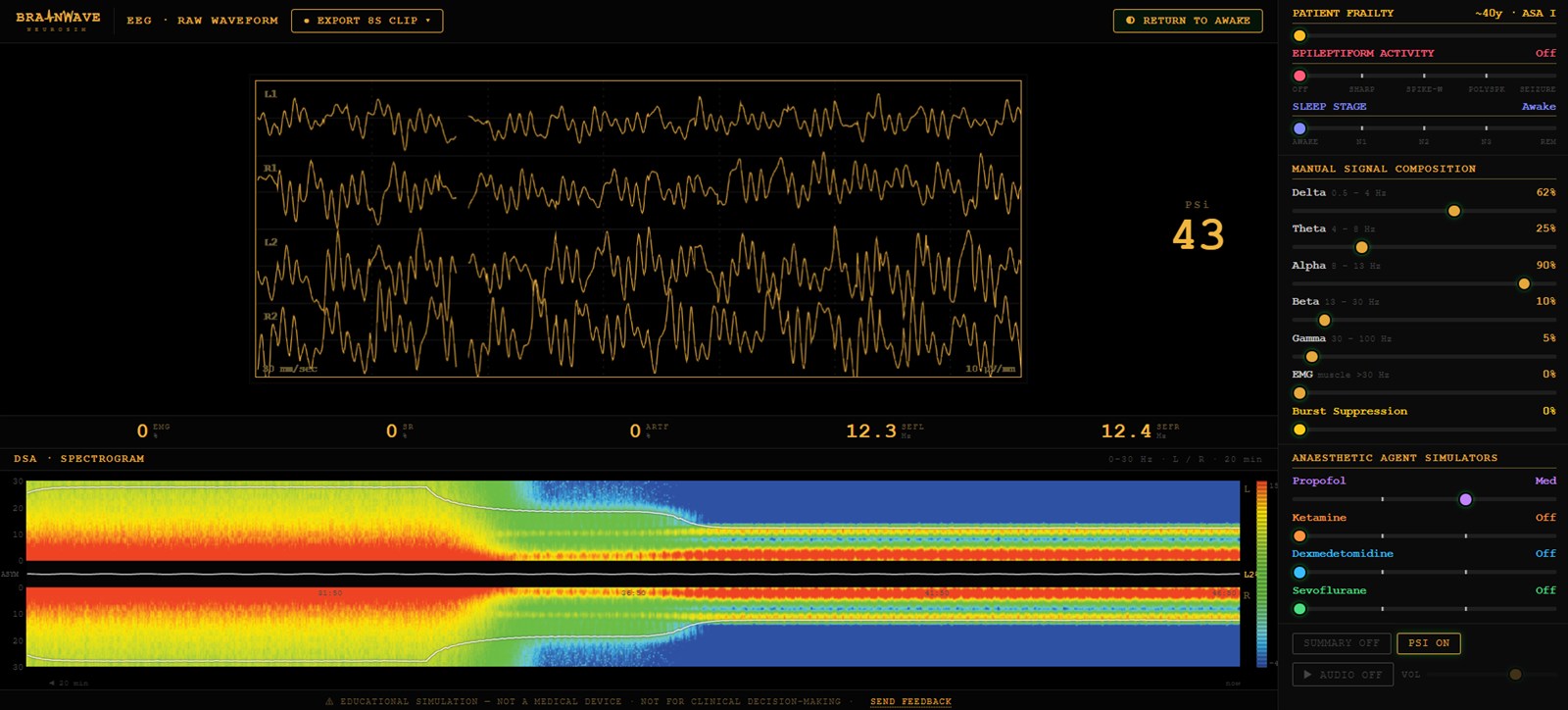
Launch the demoMove the sliders to change the waveform components, change patient frailty and explore the EEG signature with increasing propofol and ketamine doses.
Every signal is computer-generated and modelled on adult patients. Not a medical device.
Dexmedetomidine · sevoflurane (the demo covers propofol and ketamine), with a response-surface interaction model for combinations.
N1 · N2 · N3 · REM, with spindles, K-complexes, sawtooth waves and the frontal eye movements.
Sharp · spike-wave · polyspike · seizure, each with postictal slowing.
ECG pulse bleed-through · mains hum · gross movement · diathermy, each contaminating the trace and the spectrogram; diathermy also takes the Index out while it is live.
0–100, derived from the raw EEG, spectral edge and suppression ratio.
A plain-language description of the live trace.
Change the gain, sweep speed, spectrogram colour window, column width and spectral-edge percentile, and see the same signal read differently.
8-second clip: EEG, EEG + DSA, or the full window — with or without sound.
Sonify the displayed waveform.
Test your knowledge against our growing library of questions.
Open a live duplicate of the monitor in a second window and drag it to a projector or extended display.
Educator / Institutional access
Please get in touch to discuss.
This tool is for everyone. If cost is a barrier, please get in touch and we will be happy to provide you access free of charge.
Access is granted to the email address you pay with, within a few minutes, and lasts one year. By purchasing you accept the Terms of Service and the educational-use disclaimer.